
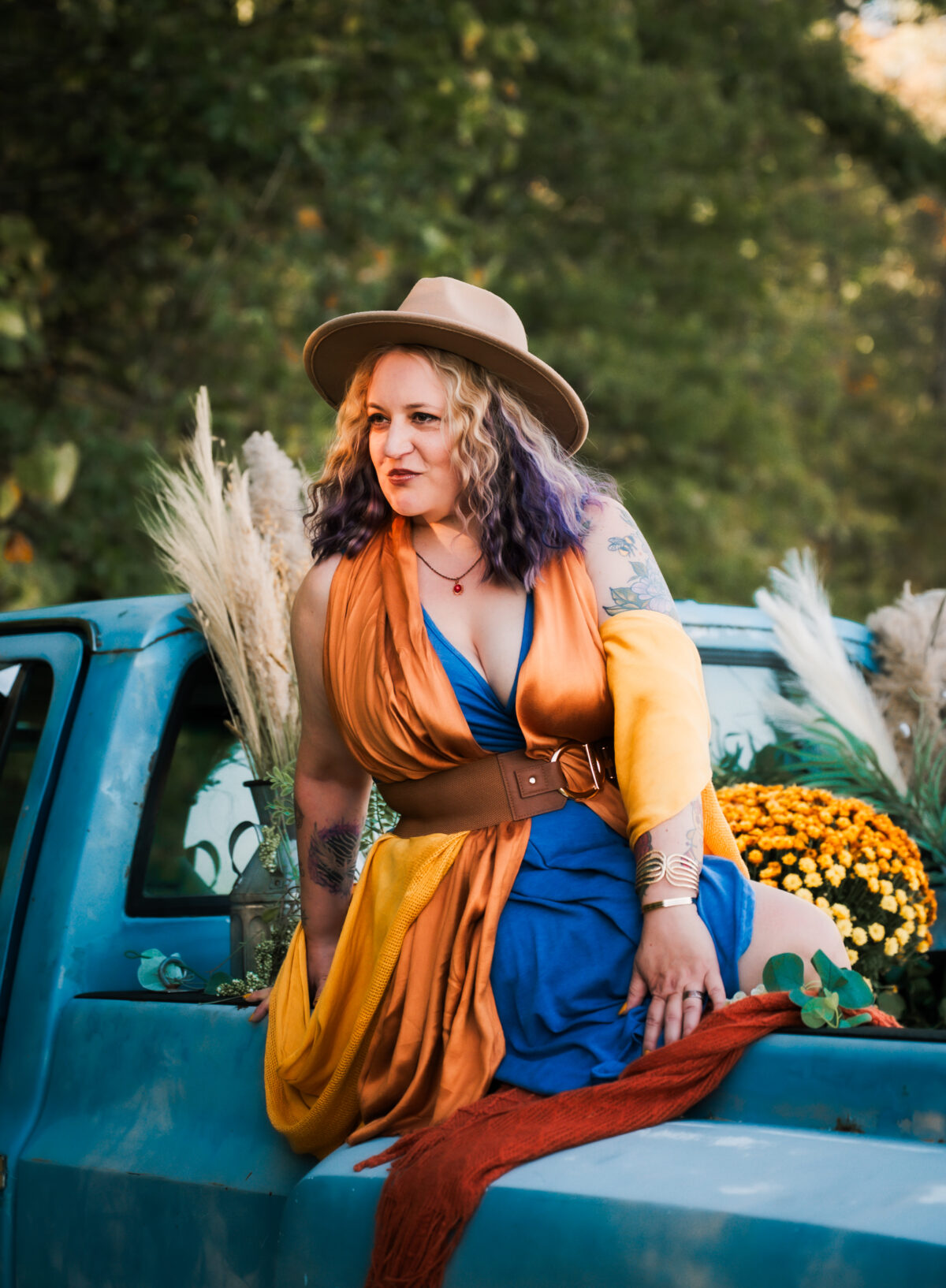
My name is Kassady Oberacker-Bailey. The diagnoses that affect me the most are Ehlers Danlos Syndrome – hypermobile type, Postural Orthostatic Tachycardia Syndrome, Gastroparesis, Bronchiectasis, Hypogammaglobulinemia, Mast Cell Activation Syndrome, ADHD, and C-PTSD.
I am the founder of both Medically Me and EDS Ohio, Inc, and I am also the president of EDS Ohio, Inc. I’ve been passionate about sharing my story with others, providing advocacy, education and support for folks with EDS and other comorbidities. Unfortunately, I made the difficult decision to close EDS Ohio in May of 2025, except for our online support communities.
I live in northeast Ohio with my husband, our dog Bowie, and our cats Maggie and Pilar. One of my favorite things to do is to read/listen to audiobooks (92 completed so far this year). I also enjoy listening to, writing, and performing music. I have a love of bird watching on our property and our possum friend that we’ve named Dr. Pepper. We enjoy going kayaking on local lakes and rivers, though we don’t get to go nearly as much as we would like to. I enjoy doing my nails and have nearly 200 polish colors and toppers. Finally, I love learning about languages and cultures. Currently, I speak fairly fluent French. I’m learning Polish, Bahasa Indonesia, and German.
5 Invisible Symptoms
- Nausea – I often find it difficult to eat because I’m nauseated. Throughout the day, I typically drink decaf coffee, some clear sodas, and maybe some water. However, water usually makes the nausea worse.
- Joint and muscle pain – Standing in line at the grocery store or even trying to lie comfortably in bed, I’m constantly trying to find a way to make whatever joint is hurting feel better. I always have to do a few yoga type stretches and adjustments, before I get into bed and then begin bracing my body with pillows for the night. My joints sublux (partially dislocate) and fully dislocate. I cannot remember a time I did not have pain.
- Poor proprioception – You know how most people will occasionally snag their shirt on a doorknob or bump into a wall? This happens to me constantly, often leaving large bruises or painful knots. I never quite feel like I know where my body is in relation to itself or other things. This has made things like yoga difficult because I cannot tell if I’m bending my body too far or placing things in the correct position.
- Dizziness – If I stand too long, I start to feel an odd type of panic or an impending sense of doom, and an immediate need to sit or lie down. Sometimes things go grey, or I start seeing floaters. I’ve had seizure-like events that are very frightening and often leave me feeling like I was hit by a bus. This can also happen if I stand up too quickly. It’s usually accompanied by tachycardia (a fast heart rate), low blood pressure, weakness, and fatigue. It’s also way worse for me, when the weather is hot or there’s direct sun.
- Migraines – I get migraines for several reasons. Usually dehydration, after my IVIG infusions for Hypogammaglobulinemia, if my blood pressure is too low and if I am experiencing hormonal changes. I become very light sensitive, cannot handle noise, and usually need to lie down in a dark, cool room. Sometimes, this lasts for days at a time.
4 Things That Help Me Manage Pain/Symptoms
- I have found life changing help with both Myofascial Release and Lymphatic Drainage treatments. Both treatments have given me far more lasting relief than any other treatment modality.
- Opioid-Sparing Infusions were recommended to me by my new pain management doctor. I had previously tried only ketamine infusions, and they were incredibly helpful, but I believe the inclusion of the other medications is giving me more global pain relief than I had with just the one medication. I’ll also mention that between trying these two medical interventions, the RN from the clinic recommended that I try Joyous. I was on their program for a year, before leaving to try the opioid sparing infusions. It worked well as a home treatment option, versus having to go into an infusion center.
- Heated blankets or heating pads. I’ll often sit on top of my heated blanket, so that all of my muscles can get full relaxation. Previously, I had both a heated mattress pad and blanket, and I’d lie between them for optimal relief in the winter.
- This has been the most valuable to me… learning it’s okay to grieve. I have learned that having negative emotions surrounding symptoms is normal, and it is okay and normal to allow myself the permission to process those feelings and emotions. Just like physical healing isn’t linear, the emotional toll we often feel isn’t either. It’s ok to admit you might need more help to cope and seek out programs like IOP (Intensive Outpatient Program) or go into an inpatient program to get help stabilizing your body and your mind. I’ll admit, it can be terrifying, but it can be a lifesaving and changing measure.
3 Ways My Life Has Changed
- In addition to my chronic illnesses, I was a passenger in a car accident in June of 2012. I lost my ability to smell and it has not returned. I suffered from Autonomic Dysreflexia and almost had a stroke. I started having seizure-like events three days after the accident that were initially 5-7 times a day and were gradually reduced with medications, medical interventions – such as massage, myofascial release, and chiropractic care with an Ehlers-Danlos Syndrome (EDS) aware chiropractor. I had to take a long-term disability leave that turned into me never returning to work, and a four-and-a-half-year fight for disability. I ended up losing my ability to drive for four years, voluntary surrender my vehicle, and was at the mercy of others to get anywhere. Eventually, we lost our home and due to the grace of people I consider family, I maintained some sort of roof over my head, and the ability to get my feet back on the ground.
- My medical treatments take a lot out of me physically. Sometimes, I end up becoming non-compliant with treatments, solely because I’m just burned out on all it takes to do all the things I am supposed to do on a daily basis. It’s not that I don’t want to do everything that could help me… I just don’t have the capacity.
- Oh, this is the best part… community. I have found a community of people who understand me. I don’t have to explain myself, justify things, or try to defend things to this beautiful community of people because they understand. I have found people who have become best friends and my chosen family. I don’t think I would’ve had the drive to start Medically Me and then EDS Ohio without the support from our community.
2 People Who Inspire Me
- Richard Riemenschneider, may he rest in peace. I first met Richard in 2012 at the Ehlers Danlos Convention in Cincinnati, Ohio through another dear friend, Luke. Richard had, at one time, been on their board. He dedicated years of his life to helping people with EDS and comorbidities. He spent time away from his wife and daughter to see to it that I wasn’t just surviving, but actually able to have some quality of life. His wife, Martha, is like a mother to me and their daughter, a sister. I felt like he was an angel on earth when I met him, and it proved to be true.
- I’m finding it hard to name just two… so I’ll consider this a classification of the doctors that have inspired me via their dedication to their patients and true humanity as medical professionals. Dr. Brad Tinkle, Dr. John Mitakides (may he rest in peace), Dr. Anne Maitland, Dr. Nizar Nader, Dr. Christopher Heller, Dr. Peter G. Striegel, Martha Riemenshneider (RN), Janine Smalley (RN), Dr. Gary Sipps, and Jeffrey Berman (MEd, MSW, LISW-S). You have all touched my life and helped me on my road to health and healing. Thank you for believing me. Thank you for helping me in my darkest moments. Thank you for celebrating my wins.
1 Thing You Want People to Know
Ehlers-Danlos Syndrome was never rare, though once classified as a rare syndrome. It was rarely diagnosed, until the past few years. There have been strong correlations with Dysautonomia/POTS, Gastroparesis, Chiari Malformation, Mast Cell Activation Syndrome and most recently, neurodivergence. EDS isn’t just being flexible or having stretchy skin, yet I still run into many doctors that still need me to spell out my conditions for them. Those of us in the community noticed the comorbidities earlier than the professionals. Most of us have had to become experts in our conditions, so we can best advocate for ourselves.
To read all of our previous zebra spotlights, please click here.
Photo by April G Photography.