
My name is Scott Besemer. I was born in 1968 and grew up in Holland, Michigan. After my freshman year of high school, my family moved to Spring Lake, where I graduated.
After high school, I didn’t really know what I wanted to do. So, I worked. Hard. Construction, pole barns, concrete, remodeling, landscaping — anything physical. I was young, strong, and willing. Landscaping led to driving a dump truck and hauling a Bobcat. Construction meant more time behind the wheel. By 1995, I decided I might as well make it official, so I attended truck driving school at Lansing Community College and earned my CDL.
I built a career in warehousing and logistics. After about 15 years, I became a regional manager for a small trucking company out of Wisconsin, overseeing the entire lower peninsula of Michigan and part of Indiana. Eventually, I returned to work for a janitorial supply company in Spring Lake that had expanded. I drove freight out of Lansing and later trained in machine repair. I was known as a hard worker — independent, strong, always finding the next task, often training other drivers.
Then December 28, 2011 changed everything.
I went to work in Grand Rapids feeling off — low energy, stomach pain. By noon I couldn’t eat. By the afternoon, I could barely stand. That night the pain became unbearable. Around 4:00 a.m., I woke my wife up and told her I needed to go to the hospital.
At the ER, they diagnosed me with pancreatitis. I was told it would run its course in a week or two. That was the last simple thing about it.
The next day I was moved to the ICU. Soon after, I was rushed into emergency surgery. What I had wasn’t ordinary pancreatitis — it was acute necrotizing pancreatitis. My pancreas was essentially digesting itself.
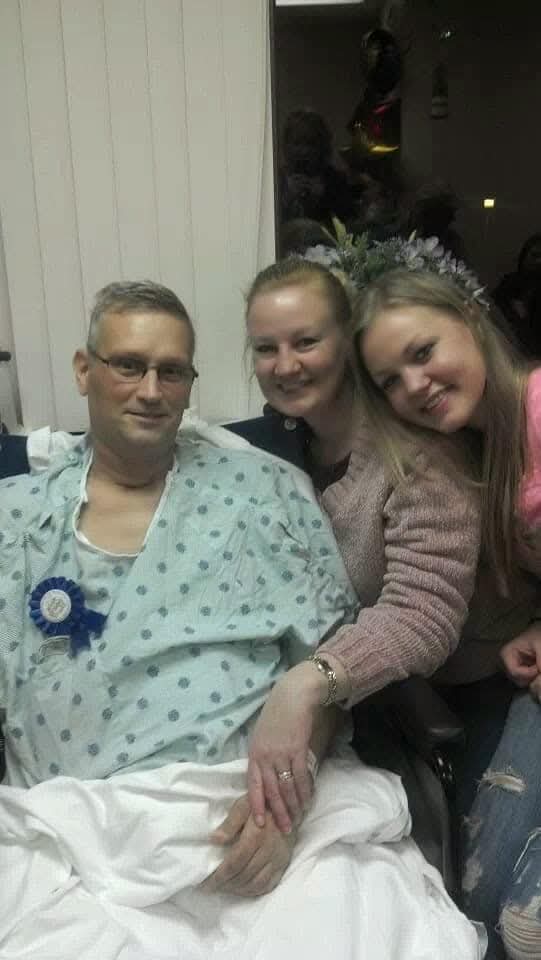
After surgery, I was placed in a medically induced coma for 21 days. My abdomen was left open. Surgeons went back in repeatedly to remove dead tissue. My kidneys began shutting down. My liver and bile duct were compressed. My gallbladder was destroyed. I had catheters and drains throughout my body. I was placed on dialysis more than once.
My abdomen remained open for weeks, packed with a wound vac. Eventually, they tried to close it by literally lacing it together like a boot, tightening it every few days. They couldn’t fully close the muscle wall and had to use mesh.
I was in the hospital four months to the day. But being discharged didn’t mean I was healed. I continued undergoing procedures through catheters for the rest of 2012. By November 6, 2012, I had undergone 35 surgeries. A 36th surgery followed in September 2014.
There were many times doctors expected me to die. I just kept not dying.
In the end, I didn’t just have pancreatitis — I had acute necrotizing pancreatitis, one of the most severe forms. My triglycerides were around 10,000, which likely triggered it.
Today, fourteen years later, I may look normal at a glance. But I am not.
I live with chronic abdominal pain every single day. There is no day without it. Because of the damage and reconstruction, I’m permanently limited to lifting ten pounds. For a man who built his life on physical strength, that has been devastating.
I have severe balance issues and have fallen many times. Ladders are out of the question. Walking any distance causes back pain because I cannot properly engage my abdominal muscles. I often need a walker.
I also live with PTSD. During my coma, I believed I was in hell — tortured, captive. My brain tried to interpret fragmented sounds and sensations. Those experiences were carried into my dreams. For years I had vivid, gruesome nightmares. I would wake up yelling for my wife, convinced it was real.
Medication has helped reduce the intensity, but I still have nightmares almost every night.
Because much of my pancreas was removed, I am now insulin-dependent. Managing blood sugar is a daily battle. I’ve woken up at 3:00 a.m. with glucose levels in the 40s — dangerously low. I keep gummies by the bed and soda in the fridge. Walking down the hallway during a crash feels like wading through cement. The Freestyle sensor has helped tremendously, but it doesn’t eliminate the fear.
These struggles are invisible.
People see me and say, “You look good.” What they don’t see is constant pain, fear of falling, humiliation in asking for help, the exhaustion of managing diabetes, or the emotional toll of losing the man I used to be.
I was the strong one. The fixer. The guy who shingled his own house, worked on cars, built things, drove trucks. I never had to ask for help.
Now I do.
That is humbling. Sometimes humiliating.
I once had a close friend accuse me of being a martyr and ended our friendship because he believed I should be back at work. What people don’t understand is that being out of the hospital does not mean being healed.
Some days I feel almost normal and think maybe I’ve turned a corner. Then the next day everything crashes back down.
My brother, who was a juvenile diabetic, was a tremendous help after I became insulin-dependent. He answered questions and gave advice. When he died in October 2022, I lost not just a resource but my best friend. His quiet strength still inspires me. He never complained or sought sympathy. I try to carry myself in the same way.
My faith has also sustained me. I don’t believe I would be here without God. I don’t know why I survived when others didn’t. I don’t pretend to understand that. But I’ve never felt alone.
There have been what I call “God things” — like receiving a wheelchair from my brother’s shed or a better walker from my mother’s hospice connections; exactly the one I couldn’t afford. Not dramatic miracles — just what I needed, when I needed it.
If there’s one thing I wish people understood, it’s this:
Just because someone isn’t crying doesn’t mean they aren’t in pain.
Just because someone looks fine doesn’t mean they are fine.
And if I ask for help, I truly need it.
I would go back to work tomorrow if I could. I would gladly trade this life of limitations for the ability to build, fix, lift, and drive again.
But this is the life I have now.
And I’m still here.